







Receive alerts when new articles are released

Your email:

About MediVisuals

MediVisuals, Inc. develops medical legal exhibits to support expert testimony. For more information, visit: www.medivisuals.com

Request a Complimentary Consultation

Have our experienced consultants review your case and provide you with a complimentary proposal and quote for medical exhibits.

Call 800-899-2153 or click HERE.

Follow MediVisuals

twitter-MediVisuals

linked-in-medivisuals

You-Tube-MediVisuals

Demonstrative Evidence Expert Articles

Current Articles | RSS Feed RSS Feed

Medical-Legal Illustrators Judged Best in Profession

  | Share on Twitter Twitter | Share on Facebook Facebook |  Add to delicious  delicious |  Share on LinkedIn LinkedIn |  Share On Technorati Technorati 

There may be no better measuring stick for an attorney than the opinions of their peers. The same is true for medical illustrators.

During the Association of Medical Illustrators (AMI) Annual Conference, each year a judged illustration competition is held. One of the largest and most competitive categories is the Medical-Legal category. Unlike most art competitions, the illustrations are not judged primarily on aesthetics. Instead, the most important criteria are anatomical accuracy and how effective the visuals are in communicating a stated message to the jury.

At the recent 2010 Conference in Portland, Oregon, the illustrations in the medical-legal category were particularly strong, resulting in the presentation of two Awards of Excellence (the highest honor) and four Awards of Merit. Illustrators with MediVisuals of Richmond, Virginia and Dallas, Texas were honored with both the Awards of Excellence and three of the four Awards of Merit. The various award winning illustrations can be seen by clicking the following link: http://www.medivisuals.com/awards.aspx.

The Award of Excellence in Medical Legal Illustration is particularly significant because this Award has only been bestowed 23 times in the 75 year history of the AMI. With this year’s Awards, MediVisuals has now received 18 of the 23.

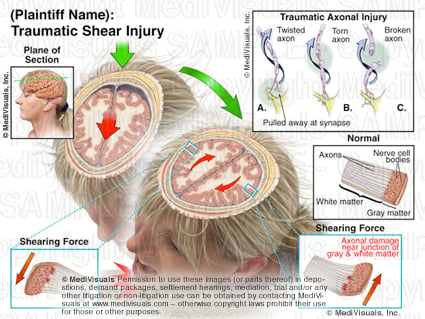
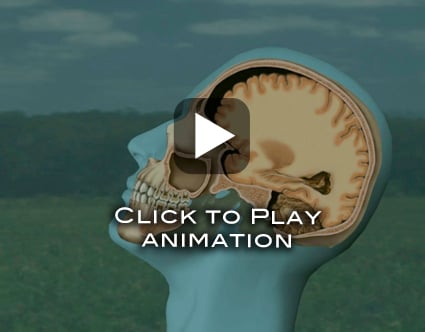
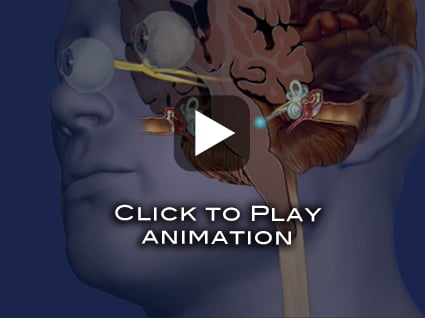
MediVisuals was also honored with an Award for a medical-legal animation entitled "Cascade Effect of Axonal Loss". The animation was developed for use in all "mild" TBI cases and helps explain how injury to even one axon can interfere with the ability of several neurons to communicate with each other. The animation can be viewed using the following link or clicking the image below: Cascade Effect of Single Axon Loss Animation

For more information on MediVisuals or to receive a complimentary consultation on an upcoming case, please visit www.medivisuals.com

Cascade Animation Screen Blog


By: Robert Shepherd, MS, Certified Medical Illustrator, Vice President and Director of Eastern Region Operations, MediVisuals Incorporated

© MediVisuals, Inc. - Permission to use any image (or parts thereof) posted on this blog in depositions, demand packages, settlement hearings, mediation, trial, and/or any other litigation or non-litigation use can be obtained by contacting MediVisuals at www.medivisuals.com – otherwise copyright laws prohibit their use for those or other purposes.

Disc Herniation and Other Disc Injuries

  | Share on Twitter Twitter | Share on Facebook Facebook |  Add to delicious  delicious |  Share on LinkedIn LinkedIn |  Share On Technorati Technorati 

By: Robert Shepherd MS, Certified Medical Illustrator, Vice President and Director of Eastern Region Operations, MediVisuals Incorporated 

The term “degenerated disc” is generally used to describe a disc in the early degenerative process.  It is the beginning of a progressive break down of the disc. This condition can be initiated or accelerated by a traumatic event.

degenerated-disc

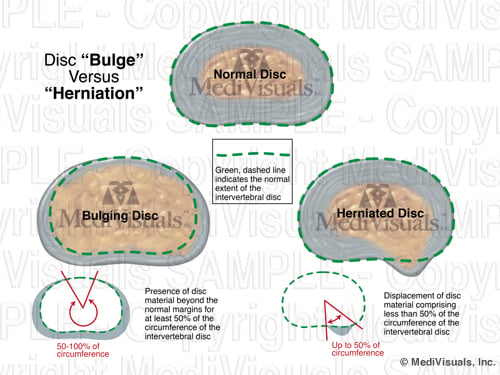
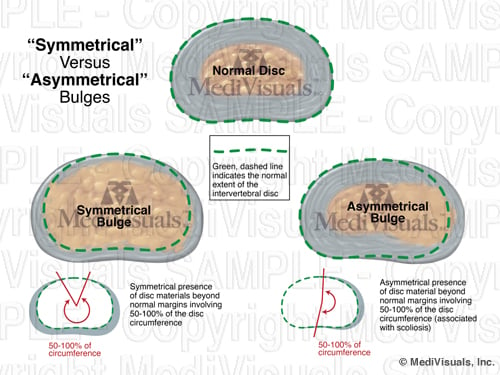
A disc bulge is a more advanced collapse of the disc to the point that the disc expands beyond its normal contour. It may or may not impinge on the neural structures within the spinal canal or neural foramina. Similarly, a disc bulge can be the immediate or delayed result of a traumatic event, or a traumatic event may exacerbate a preexisting, stable disc bulge.

annular-disc-bulge

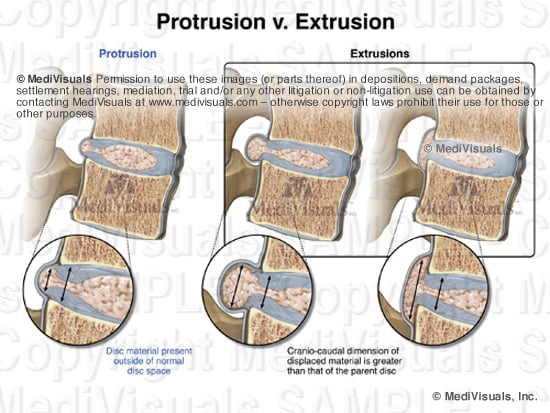
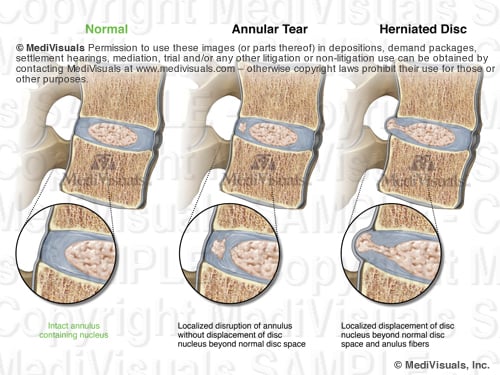
A subligamentous herniation is one in which nucleus pulposus has extended through the annulus fibrosus, but has not gone through the posterior longitudinal ligament.

subligamentous-herniation

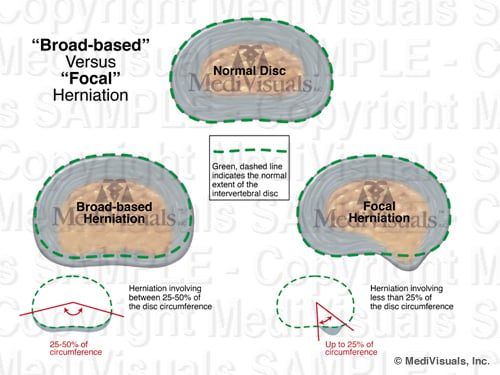
The term “herniation” is generally used when the nucleus has completely extruded through the annulus fibrosus and posterior longitudinal ligament.

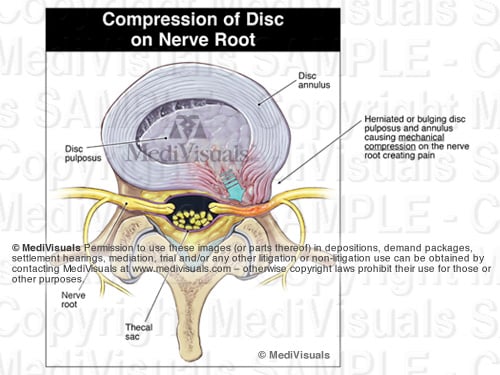
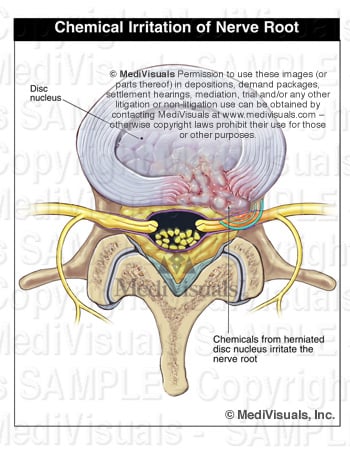
However, it does not matter what the disc pathology is labeled, if it impinges upon, or irritates the neural components, it is a significant injury that will likely require some type of invasive procedure to correct.

 impinge-disc-injury

The disc can either be injured by an immediate tear of the annulus fibrosus and extrusion of the nucleus pulposus during a traumatic event, or they can be the result of a much more gradual process. In order to understand the gradual breakdown of the disc, one must first understand a little of the physiology of a disc. The inner disc relies on exchange of fluid, nutrients and oxygen through the end plate of the adjacent vertebral bodies.

disc-anatomy

During a traumatic event, the endplate may become injured resulting in interference with that exchange.

disc-disruption

As a result of the inability of the disc to obtain the fluid, nutrients, and oxygen it needs, the disc gradually begins to break down - becoming a degenerated disc, followed by a bulging disc, and eventually to a herniated disc. The amount of time involved with the process of the disc breakdown is related to the severity of the initial disc injury.

degeneration-of-disc

Therefore, if a disc injury is not evident until weeks or months after a traumatic event, it does not mean the injury was not a direct result of the traumatic event.


© MediVisuals, Inc. - Permission to use any image (or parts thereof) posted on this blog in depositions, demand packages, settlement hearings, mediation, trial, and/or any other litigation or non-litigation use can be obtained by contacting MediVisuals at www.medivisuals.com – otherwise copyright laws prohibit their use for those or other purposes.

Breaking Down Traumatic Arthritis

  | Share on Twitter Twitter | Share on Facebook Facebook |  Add to delicious  delicious |  Share on LinkedIn LinkedIn |  Share On Technorati Technorati 

By: Robert Shepherd MS, Certified Medical Illustrator, Vice President and Director of Eastern Region Operations, MediVisuals Incorporated

Fractures can result in several long term or permanent complications that can necessitate additional surgical procedures. One of the most common long term debilitating complications is traumatic arthritis. Traumatic arthritis can affect almost any moveable joint in the body. To explain traumatic arthritis more in depth, we will be focusing on the tibiotalar (ankle) joint, as shown in the illustration to the right.

arthritis-tibiotalar-joint

As like most moveable joints, the tibiotalar joint consists of smooth articular bone covered by thick, shock-absorbing articular cartilage.

arthritis-joint-normal

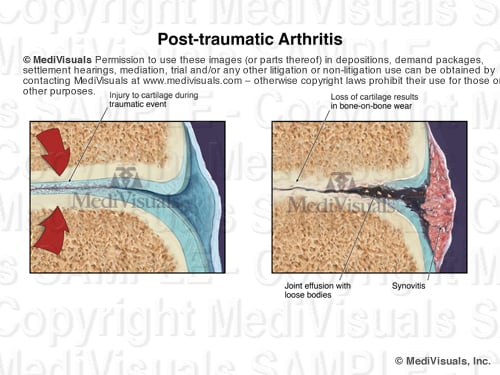
During trauma, the joint surfaces can be driven together resulting in injuries to the cartilage and microfractures of the articular surface (even without obvious intrarticular fracture).

arthritis-injury-joint

The bone and cartilage then undergo changes that result in the progressive breakdown of the joint. As the process advances, the joint becomes painful. In most cases, the only treatment options are joint replacement or fusion.

arthritis-degeneration-joint

The acromioclavicular (AC) joint also frequently falls victim to traumatic arthritis. As the AC joint enlarges (hypertrophy) it impinges on the rotator cuff, which is referred to as subacromial impingement. This can cause irritation or tearing of the rotator cuff and is most often treated by AC joint resection and subacromial decompression.

arthritis-AC-joint-shoulder


ZSN7H32E27UR

© MediVisuals, Inc. - Permission to use any image (or parts thereof) posted on this blog in depositions, demand packages, settlement hearings, mediation, trial, and/or any other litigation or non-litigation use can be obtained by contacting MediVisuals at www.medivisuals.com – otherwise copyright laws prohibit their use for those or other purposes.

Selecting a Medical Illustrator

  | Share on Twitter Twitter | Share on Facebook Facebook |  Add to delicious  delicious |  Share on LinkedIn LinkedIn |  Share On Technorati Technorati 

By: Robert Shepherd MS, Certified Medical Illustrator, Vice President and Director of Eastern Region Operations, MediVisuals Incorporated

Just as all treating physicians and/or medical experts are not the same, all medical illustrators are not the same. Attorneys typically go to great lengths to ensure that testifying experts for their cases are adequately credentialed, but many give little thought to applying the same due diligence when selecting a medical illustrator. This can be a big mistake because unlike many “professionals”, there is no basic training, licensing, or certification process that is required for an individual to call themselves a “medical illustrator”. Many less skilled and/or less qualified “medical illustrators” market to attorneys – perhaps because attorneys are less able to detect errors in their work. For these reasons, it is the responsibility of the attorney and/or medical expert to their clients to ensure they enlist the services of a medical illustrator who is qualified to provide those services.

Working with a qualified medical illustrator who has experience in the medical-legal area can be a pleasant, enjoyable experience for the testifying expert as these medical illustrators are able to read and comprehend medical records, review imaging studies, and discuss complicated anatomical and medical terms on a very similar level as the expert. On the other hand, working with an un- or minimally qualified and/or inexperienced medical illustrator can be a frustrating and time consuming task that may require multiple revisions of drafts, ineffective demonstrative aids, or even embarrassment during a hearing because of the discovery of some error or inconsistency during testimony.

It can be difficult to determine the qualifications of a medical illustrator based upon looking at their artwork alone. A copy of a résumé or curriculum vitae should be requested. One of the most basic requirements that the résumé should show would include graduation from one of the below medical illustration graduate programs. There are several medical illustration programs in colleges and various institutes in North America and across the globe; however, only five are currently accredited by the American Medical Association, and Commission on Accreditation of Allied Health Education Programs. Those programs include:

  • Medical College of Georgia - Master of Science in Medical Illustration

  • University of Illinois at Chicago - Master of Science in Biomedical Visualization

  • Johns Hopkins University - Master of Arts in Medical and Biological Illustration

  • University of Texas, Southwestern – Master of Arts in Biomedical Communications

  • University of Toronto - Master of Science in Biomedical Communications

Other criteria that should be evident in a résumé or CV that would help demonstrate at least minimal qualifications are 1) Certification as a medical illustrator as issued by The Board of Certification of Medical Illustrators and 2) Professional Membership in the Association of Medical Illustrators. Both of these require that the individual possess at least minimal medical illustration training and skill levels. Also, just as there are different subspecialties in medicine which require specific and advanced skills and knowledge, specialization in “medical-legal” illustration requires additional knowledge and experience in addition to those required for general medical illustration. For that reason, it is also wise to select a qualified medical illustrator who is not only familiar with illustration and medicine, but also has a significant amount of experience in creating illustrations for litigation purposes.


© MediVisuals, Inc. - Permission to use any image (or parts thereof) posted on this blog in depositions, demand packages, settlement hearings, mediation, trial, and/or any other litigation or non-litigation use can be obtained by contacting MediVisuals at www.medivisuals.com – otherwise copyright laws prohibit their use for those or other purposes.

Medical Illustrators as a Member of the Medical-Legal Team

  | Share on Twitter Twitter | Share on Facebook Facebook |  Add to delicious  delicious |  Share on LinkedIn LinkedIn |  Share On Technorati Technorati 

By: Robert L. Shepherd MS, Certified Medical Illustrator, Vice President and Director of Eastern Region Operations, MediVisuals Incorporated

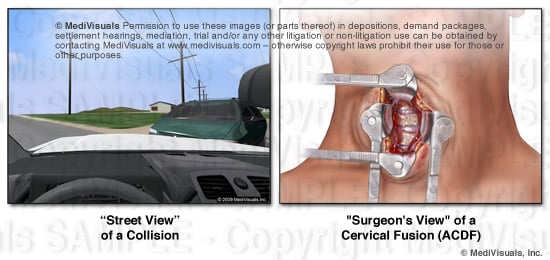
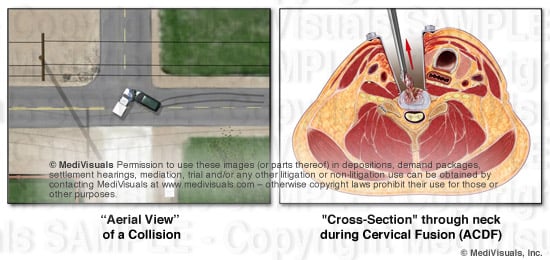
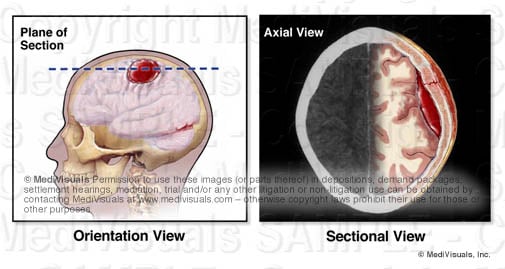
A very effective way of increasing the effectiveness of expert testimony is by enhancing focus, understanding, and recall by teaming the testifying expert with a qualified medical illustrator, experienced in preparing legal graphics (illustrations, animations, models, etc.). By working together, the medical knowledge and oral skills of the expert can be supported by expertly created medical graphics that greatly clarify complicated anatomical, physiological, and medical subtleties. Together they result in much more effective communication with the decision makers than if verbal testimony or the graphics were used alone (one mode of communication used alone without being supported by the other). In addition, during a period of hours or days of listening to arguments that are typically only verbal, decision makers grasp the opportunity to focus on visuals in the form of illustrations, photographs, models, and/or animations. In fact, information is generally better processed if jury members and other triers of fact can have information presented in a multimodal fashion (i.e. combinations of simultaneous auditory, visual, and tactile stimuli).

The effectiveness of visuals is supported throughout our society by such common phrases as “A picture is worth a thousand words”, and “Seeing is believing.” In addition, numerous manuscripts refer to studies substantiating that recall is greatly increased when the verbal message is supported by visual images. Typically these studies have shown that after varying periods of time information that was delivered by a combination of voice supported by visuals was recalled at a significantly higher percentage than the same message delivered by voice alone.

References

DeBoth, C. J., & Dominowski, R. L. Individual differences in learning: Visual versus
auditory presentation. Journal of Educational Psychology, 1978; Aug 70 (4): 498-503

McCall, J., & Rae, G. Relative efficiency of visual, auditory and combined modes of
presentation in learning of paired-associates. Perceptual and Motor Skills, 1974; June (38) : 955-958.

Multimodal Learning Through Media: What the Research Says. Cisco Web site. http://www.cisco.com/web/strategy/docs/education/Multimodal-Learning-Through-Media.pdf. Accessed August 19, 2008.


© MediVisuals, Inc. - Permission to use any image (or parts thereof) posted on this blog in depositions, demand packages, settlement hearings, mediation, trial, and/or any other litigation or non-litigation use can be obtained by contacting MediVisuals at www.medivisuals.com – otherwise copyright laws prohibit their use for those or other purposes.

All Posts